
Want to learn more about our solutions?
Contact the VUNO team anytime.
Contact the VUNO team anytime.
Analyzes 12-lead ECG data with AI to provide screening assistance for four cardiac and renal conditions: LVSD, AMI, Hyperkalemia, and Kidney disease.
[Evaluation-Deferred New Health Technology*] · VUNO Med®-DeepECG® LVSD · Period: 2026.04.01–2028.03.31
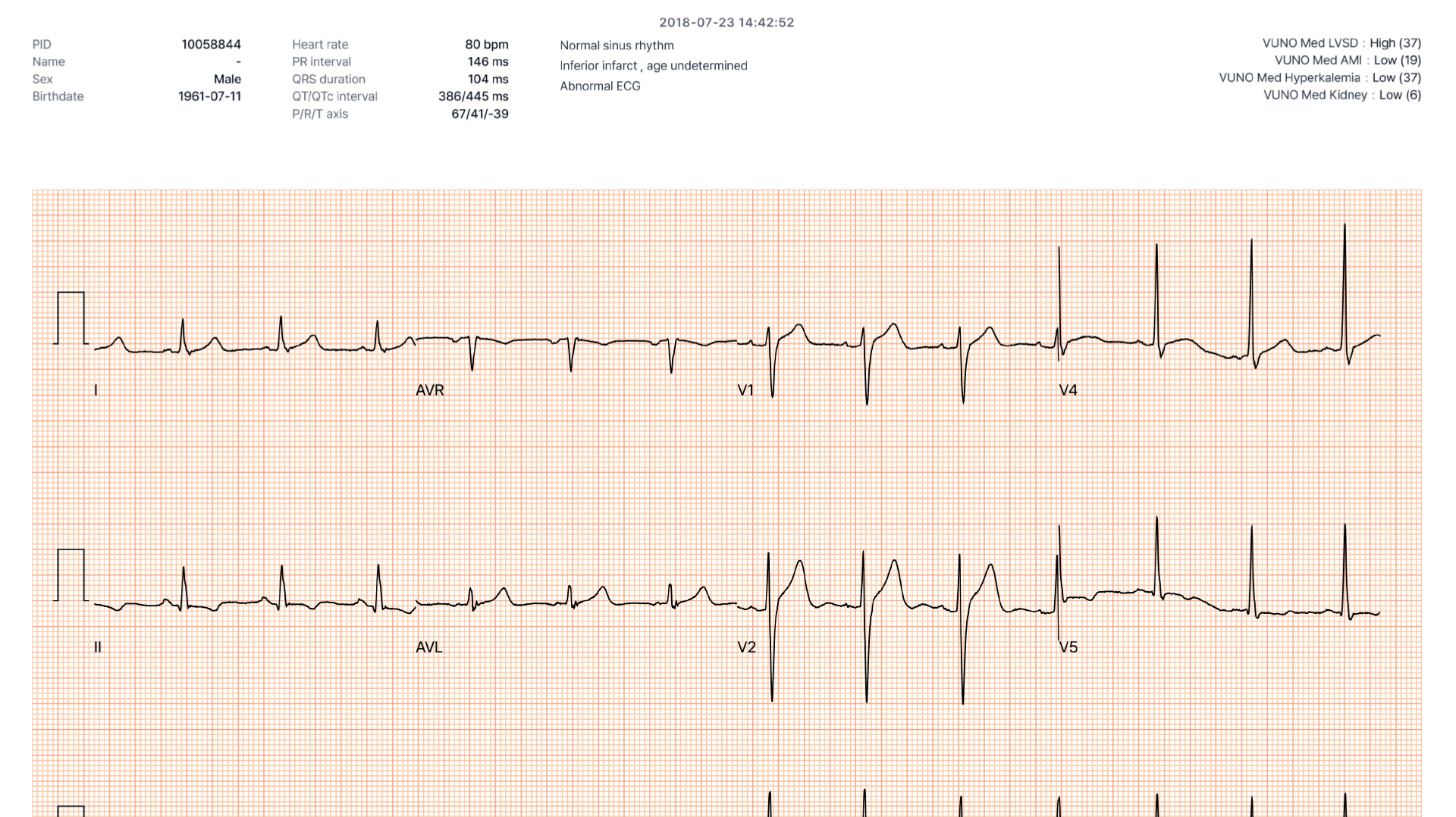
[VUNO Med®-DeepECG® UniV]VUNO Med®-DeepECG® UniV is software that retrieves and displays the analysis results of VUNO Med®-DeepECG® LVSD, AMI, Hyperkalemia, and Kidney.
[Evaluation-Deferred New Health Technology*] · VUNO Med®-DeepECG® LVSD · Period: 2026.04.01–2028.03.31
Based on 12-lead ECG data, DeepECG analyzes screening information for LVSD, AMI, Hyperkalemia, and Chronic Kidney Disease, assisting clinicians in determining the need for further evaluation.
Based on 12-lead ECG data, DeepECG analyzes screening information for LVSD, AMI, Hyperkalemia, and Chronic Kidney Disease, assisting clinicians in determining the need for further evaluation.
Screens for possible LVSD to help identify heart failure risk groups. It can also help evaluate patients at an asymptomatic stage, who may be missed by visual ECG interpretation alone.
Screens ECG signals suggestive of acute myocardial infarction to assist reperfusion decisions. Provides rapid screening information for emergency patients whose atypical symptoms may delay diagnosis.
Non-invasively screens for possible hyperkalemia before blood tests. A single ECG can flag potential risk signals even in settings where repeated blood draws are difficult.
Screens for possible kidney dysfunction through non-invasive ECG analysis. Provides screening information that may help connect asymptomatic CKD patients to further evaluation.
DeepECG was trained and validated on large-scale clinical datasets, demonstrating high discriminative performance across cardiac and renal conditions. AUROC values are based on 12-lead ECG confirmatory clinical trial data approved by MFDS.
DeepECG was trained and validated on large-scale clinical datasets, demonstrating high discriminative performance across cardiac and renal conditions. AUROC values are based on 12-lead ECG confirmatory clinical trial data approved by MFDS.
※ The clinical results above were obtained in the subjects and conditions of each clinical trial and may differ from the performance stated in the product's regulatory approval.
※ Approved performance by product
Without additional blood draws or imaging, a single 12-lead ECG provides screening information for all four conditions. Integrates seamlessly into outpatient, screening, emergency, and inpatient workflows wherever ECG is used.
Without additional blood draws or imaging, a single 12-lead ECG provides screening information for all four conditions. Integrates seamlessly into outpatient, screening, emergency, and inpatient workflows wherever ECG is used.

This product does not replace conventional diagnostic tests such as echocardiography or blood tests. It provides screening information to assist clinical judgment. Final diagnosis and treatment decisions must be made by healthcare professionals.

Links to news about VUNO (excluded from medical device advertisement review)
This section is excluded from medical device advertisement review; it links to news related to our company.
VUNO Med®-DeepECG® is an AI-based ECG analysis solution that analyzes 12-lead ECG data with artificial intelligence to provide the possibility and risk level of specific diseases that are difficult to identify by visual interpretation alone, assisting medical professionals in clinical decision-making. DeepECG® is an ECG-based analysis software brand, and individual AI analysis products for each condition — DeepECG AMI, LVSD, Hyperkalemia, and Kidney — have received regulatory approval. It complements the existing ECG workflow by providing reference information to help determine whether additional evaluation is needed and to screen patients.
DeepECG® analysis results do not constitute a definitive or final diagnosis. They provide reference information to help medical professionals make comprehensive judgments by combining the patient's symptoms, medical history, existing ECG interpretation, and test results. Therefore, DeepECG® results should always be used in conjunction with the professional judgment of medical professionals.
DeepECG® is designed to work in conjunction with the ECG workflow within hospitals. The actual integration method may vary depending on the hospital's equipment configuration, data formats, network, and information system environment. A technical review is conducted before deployment to confirm the appropriate usage and integration approach.
No. DeepECG® is not intended to replace echocardiography, blood tests, or clinical judgment by medical professionals. It is an assistive tool that provides reference information on the possibility or risk level of specific conditions at the ECG stage, helping medical professionals determine whether additional evaluation is needed for a patient.
Ad review no.: 62026-|10-31-3898 (valid until 2029-09-16)│This product is a ‘medical device’. Read the ‘precautions for use’ and the ‘instructions for use’ carefully before use.│Category : Digital medical device│Model / Intended use : VN-C-12 / Software that screens for left ventricular systolic dysfunction by analyzing 12-lead ECG data, used to help physicians determine the need for further examination│Model / Intended use : VN-C-15 / AI-based software that helps screen for reduced kidney function by analyzing ECG data (12-lead)│Model / Intended use : VN-C-06 / AI-based software used to screen for hyperkalemia by analyzing ECG data (12-lead)│Model / Intended use : VN-C-08 / Software that screens for acute myocardial infarction by analyzing 12-lead ECG data to assist the diagnostic decisions of physicians│Product / Intended use : VUNO Med-DeepECG UniV / Software used by healthcare professionals to integrate and manage information on patients who underwent ECG examinations at a medical institution — it transmits ECG data received from ECG devices to a separate analysis server and provides the analysis results