
Want to learn more about our solutions?
Contact the VUNO team anytime.
Contact the VUNO team anytime.
Predict cardiac arrest risk within 24 hours from patient vital signs.
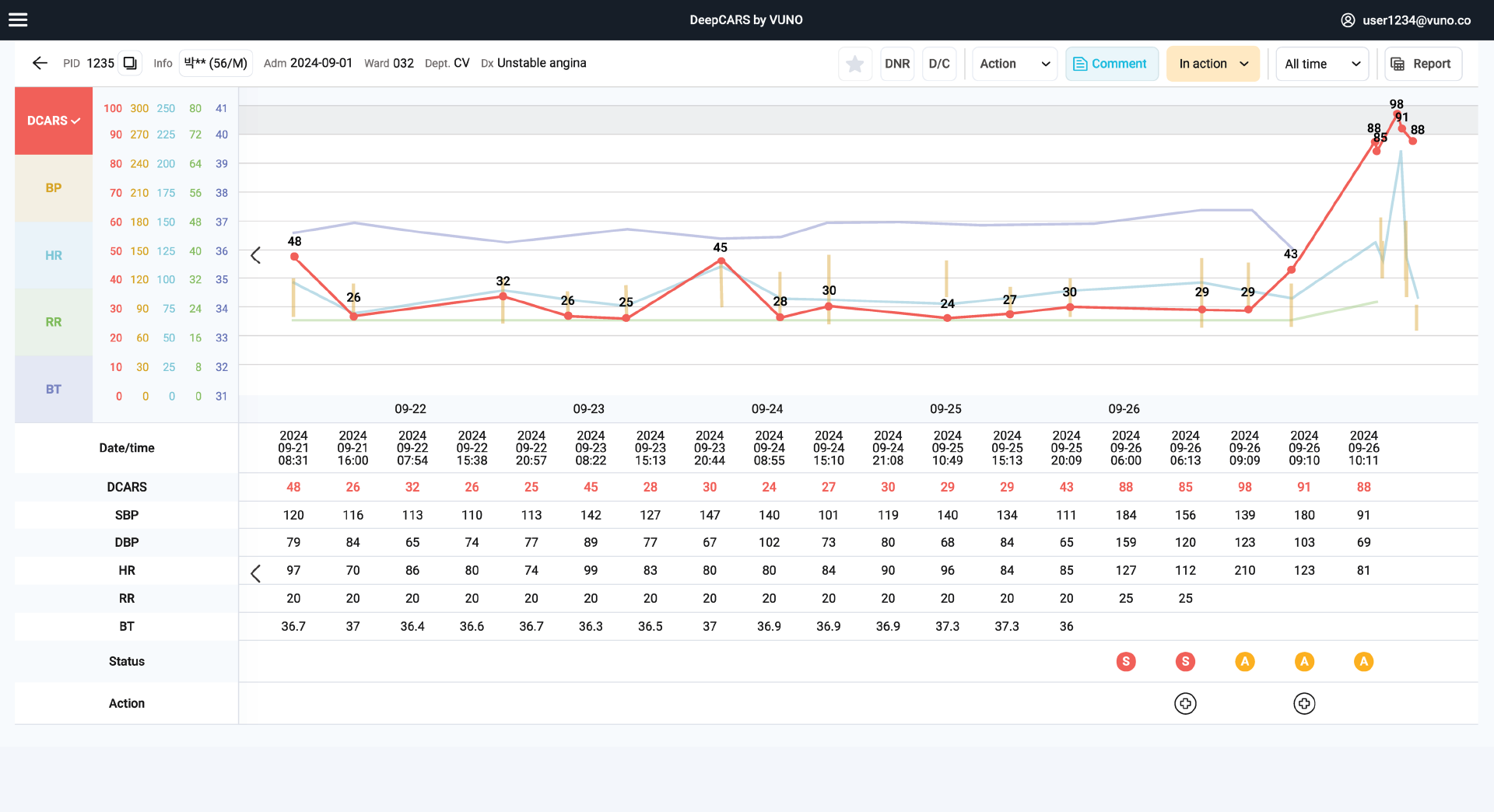
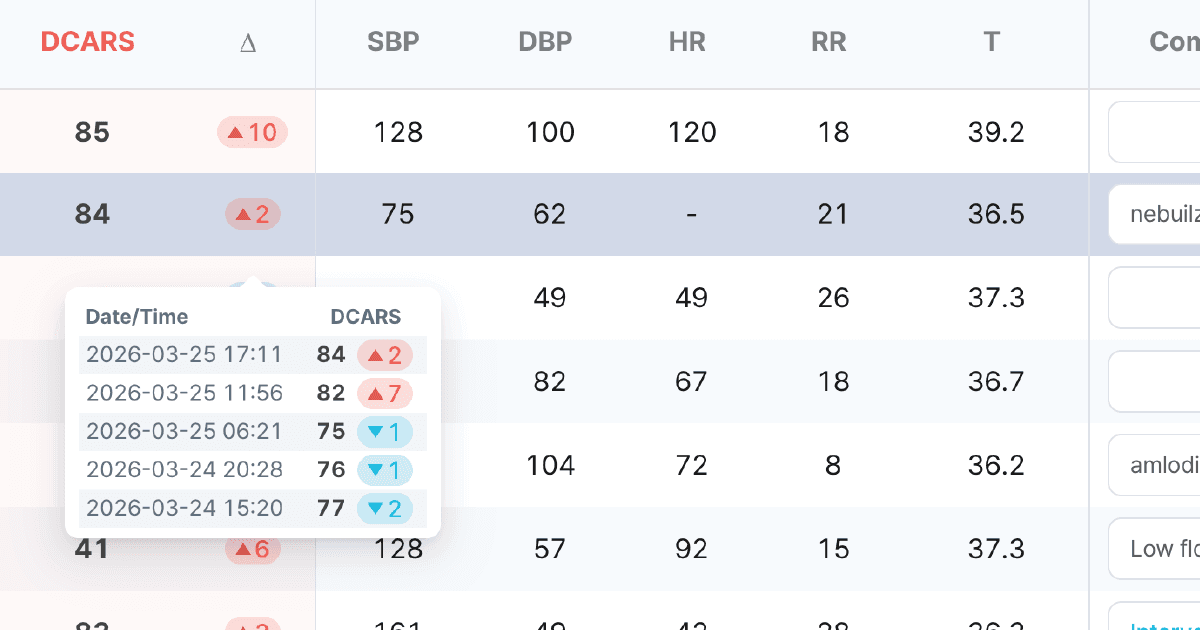
DeepCARS collects five vital signs from the EMR — systolic and diastolic blood pressure, pulse rate, respiratory rate, and body temperature. A deep learning algorithm analyzes them and outputs a 0–100 score reflecting the patient's cardiac arrest risk within 24 hours, supporting in-patient monitoring and proactive response.
 Age
 Time
 BP(Sys / Dia)
 Pulse
 Resp.
 Temp


Blood pressure, pulse rate, respiratory rate, and temperature flow into DeepCARS via routine EMR entry — no workflow changes required.
Cardiac arrest risk discrimination · All 2,585 trial subjects
Cardiac arrest risk discrimination · 6 subgroups by age, sex, and department



Links to news about VUNO (excluded from medical device advertisement review)
This section is excluded from medical device advertisement review; it links to news related to our company.
DeepCARS can be used for patients of all ages admitted to general wards. [Note] General ward beds: inpatient beds excluding emergency rooms, nurseries, delivery rooms, recovery rooms, ICUs, intensive care units, isolation rooms, sterile treatment rooms, hemodialysis rooms, special treatment rooms, day wards, etc. Isolation rooms, sterile treatment rooms, and similar rooms that are not operated as separate wards are considered general ward beds.
Conventional early warning systems use a standardized approach that simply sums risk scores for individual clinical indicators such as vital signs and consciousness level. In contrast, DeepCARS applies deep-learning-based time-series analysis to comprehensively analyze temporal change patterns across various clinical data, providing a risk score for cardiac arrest within 24 hours. Clinical studies have confirmed the product's effectiveness in terms of predictive performance and alarm rate. [Note] Time-series analysis: an analytical method in which AI continuously collects and analyzes patient vital sign data over time to identify change patterns and anomalies.
No additional tests or equipment are required. DeepCARS operates using only the four basic vital signs (blood pressure, pulse rate, respiratory rate, body temperature) routinely measured and recorded for general ward inpatients, plus measurement timestamps and patient age. It analyzes vital sign data entered in the electronic medical record (EMR) and provides a cardiac arrest risk score within 24 hours, so it can be used within existing ward operations without blood draws or other additional procedures or new equipment.
On the contrary, DeepCARS is designed to reduce alarm burden. In a prospective multicenter clinical study, DeepCARS showed a significantly lower daily alarm count per 1,000 beds compared to conventional EWS at the same sensitivity threshold, while the appropriate alarm ratio for patients who actually experienced clinical deterioration was higher. In other words, it reduces unnecessary alarms while improving accuracy for truly high-risk patients, enabling medical staff to focus on proactive intervention. [Note] Alarm fatigue: a phenomenon in which frequent alarms cause medical staff to become desensitized, delaying their response to actual danger signals. It has been reported as a major clinical issue that can affect patient safety.
Ad review no.: 62026-|10-36-4546 (valid until 2029-10-12)│This product is a ‘medical device’. Read the ‘precautions for use’ and the ‘instructions for use’ carefully before use.│Category : Digital medical device│Intended use : Software that analyzes vital signs collected from electronic medical records of general-ward inpatients, provides the risk of cardiac arrest as a score between 0 and 100, and transmits it to an EMR, a central patient monitoring system, or a separate user interface